

This project focused on participating in collaborative review cycles for Operator and Service Manuals across Peterbilt and Kenworth product lines. I contributed detailed editorial feedback on grammar, clarity, structure, and style guide compliance, helping refine safety-critical manuals for accuracy and consistency.
Goals
The goals of the project included:
- ensuring accuracy and clarity across technical documentation
- enforcing style guide compliance across multiple brands and manuals
- collaborating with SMEs and technical authors in a shared review process
- strengthening document structure and editorial consistency
Objectives
The primary objectives of this project were to:
- review manuals for grammar, clarity, and style compliance
- analyze technical content for consistency and usability
- provide actionable comments to authors and SMEs during reviews
- develop hands-on experience with PACCAR’s collaborative workflows
Outcome
The project achieved the following results:
Editorial Contributions
Approximately 450 comments across 10 manuals, spanning troubleshooting guides, operator displays, and MX-10 integrations.
Improved Clarity & Structure
Refined safety messages, parallel structure, and legacy content sections.
Cross-Brand Experience
Reviewed manuals across Peterbilt and Kenworth product lines, including multiple truck models.
Practical Workflow Skills
Developed proficiency with Adobe Shared Review tools and PACCAR’s Manual Review Process documentation.
Approach
Operator and Service Manuals are critical reference materials for drivers and technicians. Errors or inconsistencies can undermine safety, productivity, and brand trust. Collaborative reviews bring together SMEs, engineers, and editors to ensure quality from multiple perspectives.
I worked closely with technical content liaisons Courtney (Service Manuals) and Sarah (Operator Manuals) to complete three review projects:
- Project I: Vehicle Component Service Manual
Reviewed 448 pages, including a 269-page Troubleshooting section covering 56 diagnostic codes. I contributed 53 comments in Troubleshooting and 20 comments in legacy sections, focusing on clarity, grammar, and consistency. - Project II: Vehicle Component Operator Manuals
Reviewed two 55-page manuals with 15 updated topics, leaving 25 comments on new sections and nearly 150 on legacy sections. I also reviewed two larger operator manuals, adding 120 comments focused on style, parallel structure, and alignment with the PACCAR Style Guide. - Project III: Engine/Vehicle Integration Manuals
Reviewed the 417-page Model 579 manual (78 comments on 14 new topics and 84 updated safety messages) and several smaller manuals (LCF, Medium Duty, Car Carrier, etc.), leaving targeted comments on safety messages and structural edits.
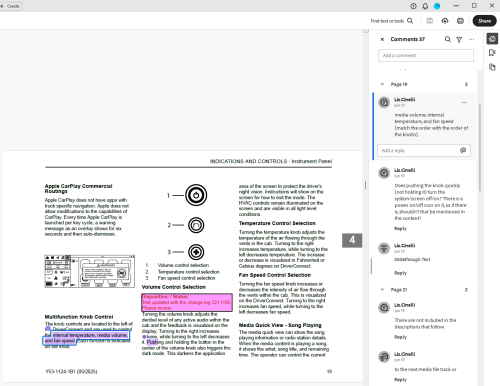
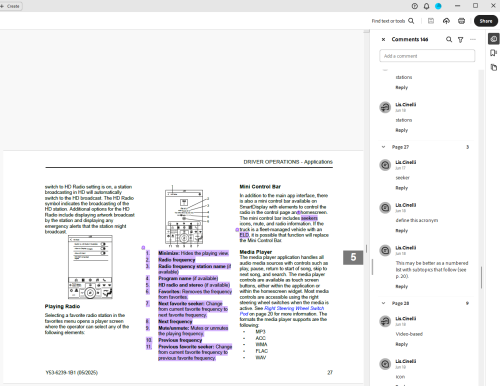
Throughout, I applied technical editing best practices, using Adobe Acrobat’s shared review tools to submit precise, actionable feedback. My comments addressed clarity, parallel structure, tagging, style adherence, and readability, while also ensuring technical content accuracy.
This project highlights my ability to edit at scale, enforce consistency, and collaborate with cross-functional teams in high-stakes documentation processes.
Final Deliverable
The final deliverable is not a public-facing product but a set of Operator and Service Manuals reviewed and refined through collaborative feedback cycles. All editorial contributions and value remain within PACCAR’s internal documentation systems. Updated manuals are either not yet published due to production cycles or are restricted from distribution outside the company.