
This project focused on consolidating and authoring reusable safety messages in PACCAR’s Content Lifecycle System (CLS). By analyzing redundant entries, aligning them with PACCAR’s Style Guide, and collaborating with SMEs, Legal, and Safety & Compliance, I streamlined documentation to improve clarity, compliance, and reuse across multiple manuals.
Goals
The goals of the project included:
- reducing redundancy in safety-related documentation
- aligning safety content with PACCAR’s Style Guide and corporate standards
- ensuring legal and compliance accuracy through multi-stakeholder review
- strengthening content reuse across CLS to support long-term efficiency
Objectives
The primary objectives of this project were to:
- review potentially duplicate safety messages in the CLS backlog
- revise and consolidate content into clear, reusable topics
- consult with SMEs, Legal, and Safety & Compliance for approval
- author the approved content in CLS and archive outdated versions
Outcome
The project achieved the following results:
Reduced Redundancy
Consolidated multiple overlapping safety messages into single, reusable topics.
Improved Clarity & Compliance
Revised content aligned with corporate standards and compliance requirements.
Reusable Content Structure
Safety messages authored as standardized topics in CLS for use across multiple manuals.
Project Management Experience
Managed a full authoring cycle from analysis to authoring.
Approach
Safety content is high-stakes: unclear or inconsistent wording can create compliance risks and compromise end-user safety. Authoring reusable, standardized messages ensures that critical warnings remain clear, accurate, and consistent across all PACCAR manuals.
The process began with reviewing safety message change log requests (CH-1176, CH-1177, CH-1244, CH-1261). Each request flagged duplicate or inconsistent safety messages in the backlog. I analyzed the existing content against PACCAR’s four-part safety message structure (signal word, hazard description, consequence, and avoidance instructions).
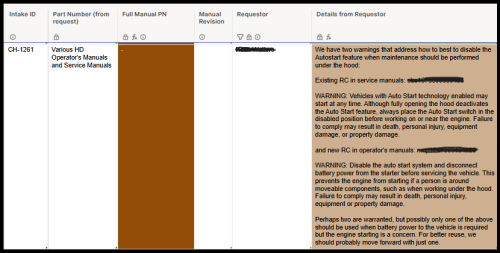
I consolidated duplicates into a single reusable message, revising language for clarity, precision, and alignment with PACCAR’s Style Guide. To ensure compliance, I collaborated with an in-house technical author and consulted subject-matter experts (SMEs), Legal, and Safety & Compliance for approval. Once approved, I authored the new reusable message in CLS and archived outdated versions to prevent reuse.
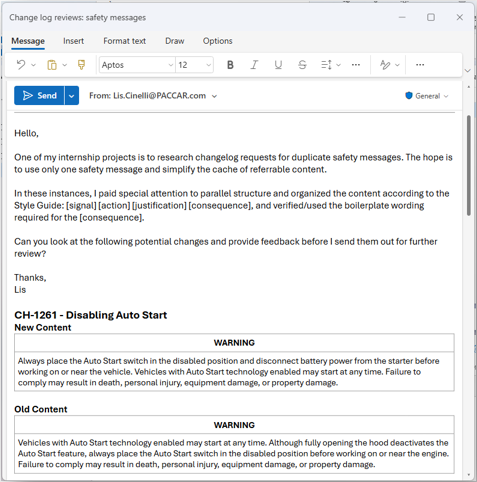
A key principle applied in this work was “responsible ambiguity,” meaning the messages were written broadly enough to be reused across multiple manuals while still meeting clarity and compliance requirements.
This project demonstrates my ability to manage a full technical writing cycle, collaborate with cross-functional stakeholders, and author high-stakes safety content that balances compliance, clarity, and reuse.
Final Deliverable
The final deliverable is a set of reusable safety messages authored and standardized in CLS. These messages now serve as shared content across PACCAR manuals, improving efficiency, compliance, and clarity. Updated manuals containing these safety messages are not yet available due to publishing cycles or may be restricted from distribution outside the company.